Press kit
Everything a reporter needs, on one page.
Who we are, what we’re asking, the facts with sources, quotes you can use, and files you can download. For interviews: Jason Comely, hello@makehelpvisible.ca, 226-581-8826.
In one paragraph
Make Help Visible is a Canadian campaign for warning-and-help signs at every drug consumption site in the country. It is promoted by Referee The Room, which trains frontline shelter and outreach staff. Posters, facts and contacts: makehelpvisible.ca.
The ask
One condition on every federal exemption: a plain-language warning-and-help sign at the entrance and inside the consumption room, in English and French, naming what the drugs do, the local 24-hour help line, and the words “Ask staff about treatment today.”
Quotes you can use
Attribute to Jason Comely, founder, Make Help Visible.
Facts, with sources
- Health Canada lists 26 supervised consumption sites operating under federal exemption (September 15, 2026). British Columbia runs additional overdose prevention sites under a provincial order. Source
- The federal Minister of Health may attach any terms and conditions to a site’s exemption (Controlled Drugs and Substances Act, s. 56.1). Health Canada’s published requirements cover staffing, security, records and reporting; none requires a health warning or help information for the people inside. Source
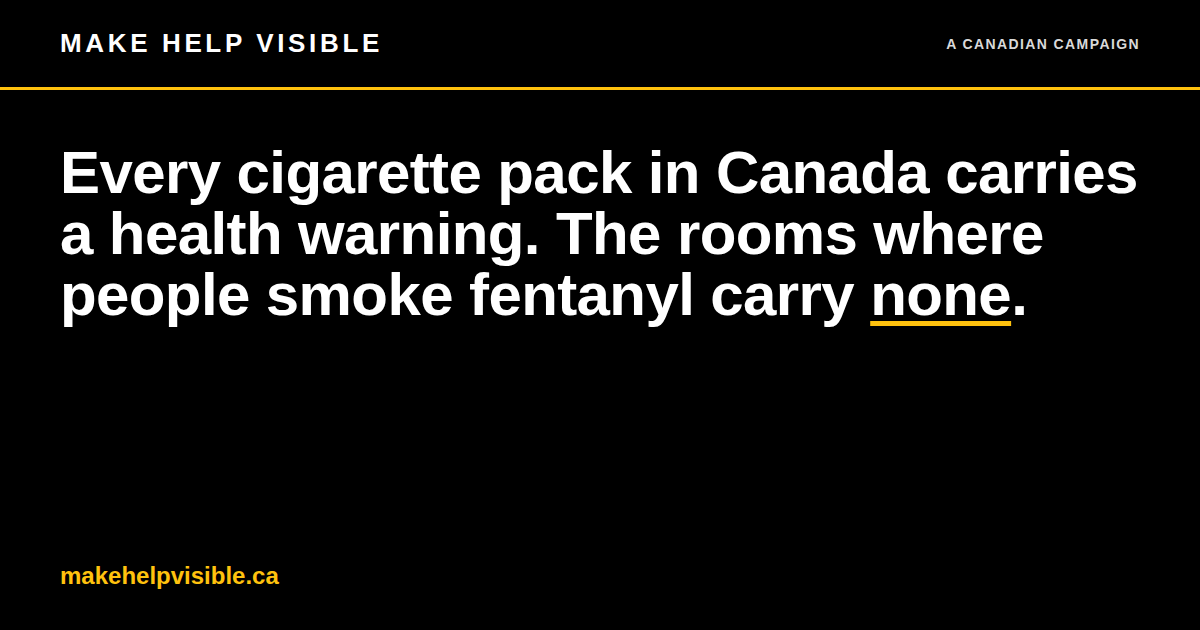
- Cigarette packages must carry health warnings covering 75% of the front and back. Source
- Medetomidine, an animal sedative, was found in 12% of Ontario fentanyl samples in August 2024 and 86% by February 2026 (Health Canada’s Drug Analysis Service, reported by CCENDU, June 2026). Toronto’s drug checking service found a benzodiazepine-related drug in 38% of fentanyl samples in February 2026. Source
- Ontario ended provincial funding for its last supervised consumption sites on June 13, 2026, in favour of Homelessness and Addiction Recovery Treatment hubs. Source
- Fentanyl overdose survivors have been left unable to form new memories (opioid-associated amnestic syndrome), described in the medical literature since 2017. Source
- Health Canada publishes a substance-use help line for every province and territory. The posters use those lines. Source
Background
Files




Media release
For immediate release
New Canadian campaign asks Health Canada to require warning-and-help signs at every supervised consumption site
Free posters with each province’s 24-hour help line available now at makehelpvisible.ca
CAMBRIDGE, Ont., October 5, 2026 — Make Help Visible, a Canadian campaign launched this month, is asking the federal Minister of Health to add one condition to every supervised consumption site exemption: a plain-language warning-and-help sign at the entrance and inside the consumption room.
Health Canada lists 26 sites operating under federal exemption, and British Columbia runs more under a provincial order. None is required to post a health warning or a way to get help. Cigarette packages carry warnings on 75% of their surface. Every cannabis package carries one. Every bar in Ontario posts a pregnancy warning by law.
The drugs have changed. Health Canada’s own lab found medetomidine, an animal sedative, in 86% of Ontario fentanyl samples by February 2026, up from 12% in August 2024. Toronto’s drug checking service found a benzodiazepine-related drug in 38% of fentanyl samples. “Public health posts these alerts online,” said Jason Comely, founder of Make Help Visible. “The room where people use the drugs posts nothing.”
The campaign offers three free posters, one each on methamphetamine and dental damage, fentanyl and brain injury, and xylazine wounds. Each names a health effect, a next step, and the 24-hour help line Health Canada lists for the reader’s province or territory, in versions for all thirteen. They are free to print under a Creative Commons licence.
“This isn’t about closing anything. It’s about what’s on the wall. A site can hand out supplies all day. It should also tell people what the drugs do and where to get help,” said Comely.
The website provides ready-to-send emails to the federal Minister of Health, to each provincial and territorial health minister, and to local sites, and asks sites that refuse to post a sign to say why in writing.
About Make Help Visible. Make Help Visible is a Canadian campaign for warning-and-help signs at every drug consumption site in the country. It is promoted by Referee The Room, which trains frontline shelter and outreach staff. Posters, facts and contacts: makehelpvisible.ca.
Media contact: Jason Comely, hello@makehelpvisible.ca, 226-581-8826.